


Blazing a trail
Pensacola’s female firefighters
By Cynthia Reeves / Photos by Kate Treick Photography
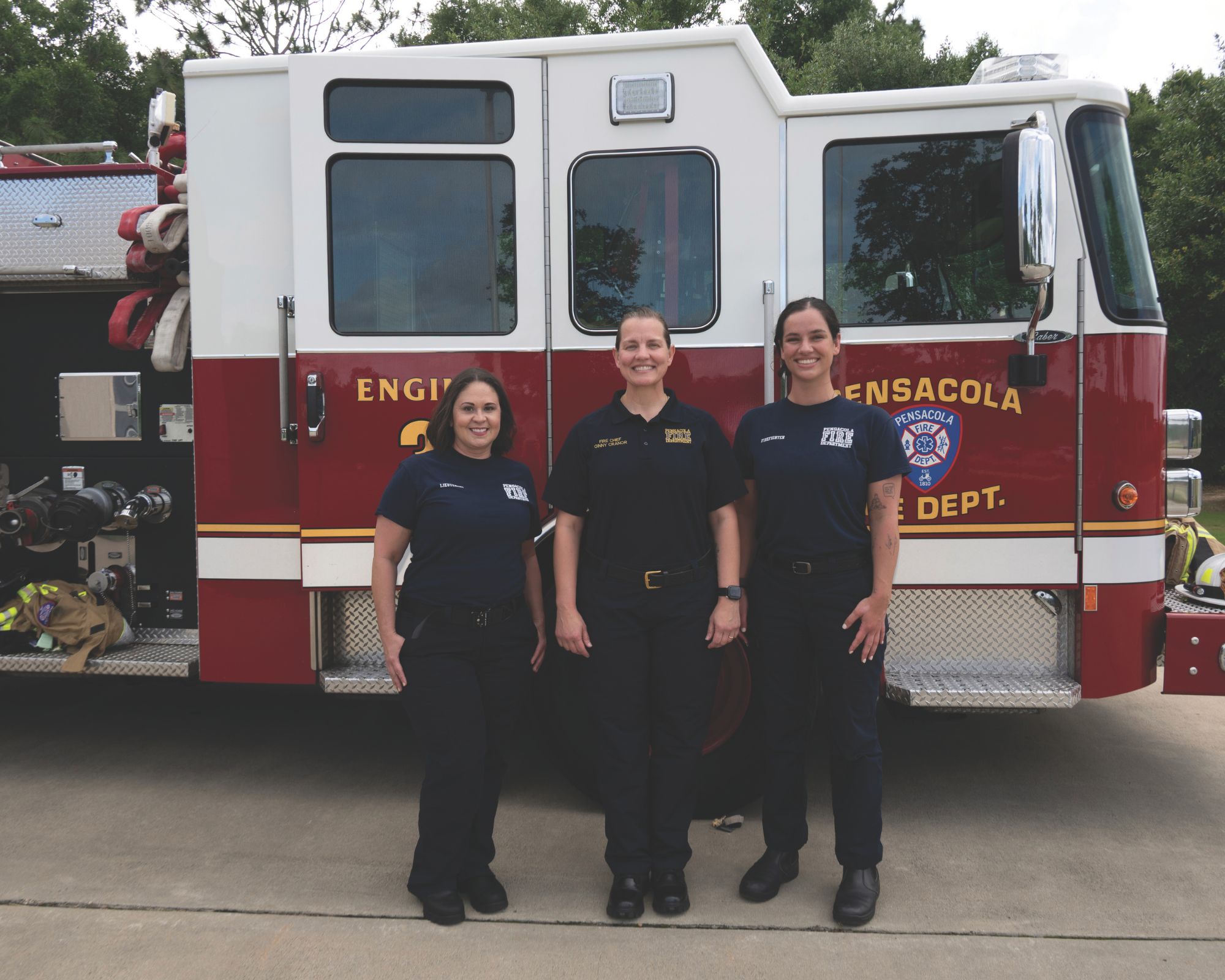
Dedication, honor, professionalism and compassion. These are the core values of the Pensacola Fire Department, a department whose chief is one of the nation’s few female firefighters in a leadership position.
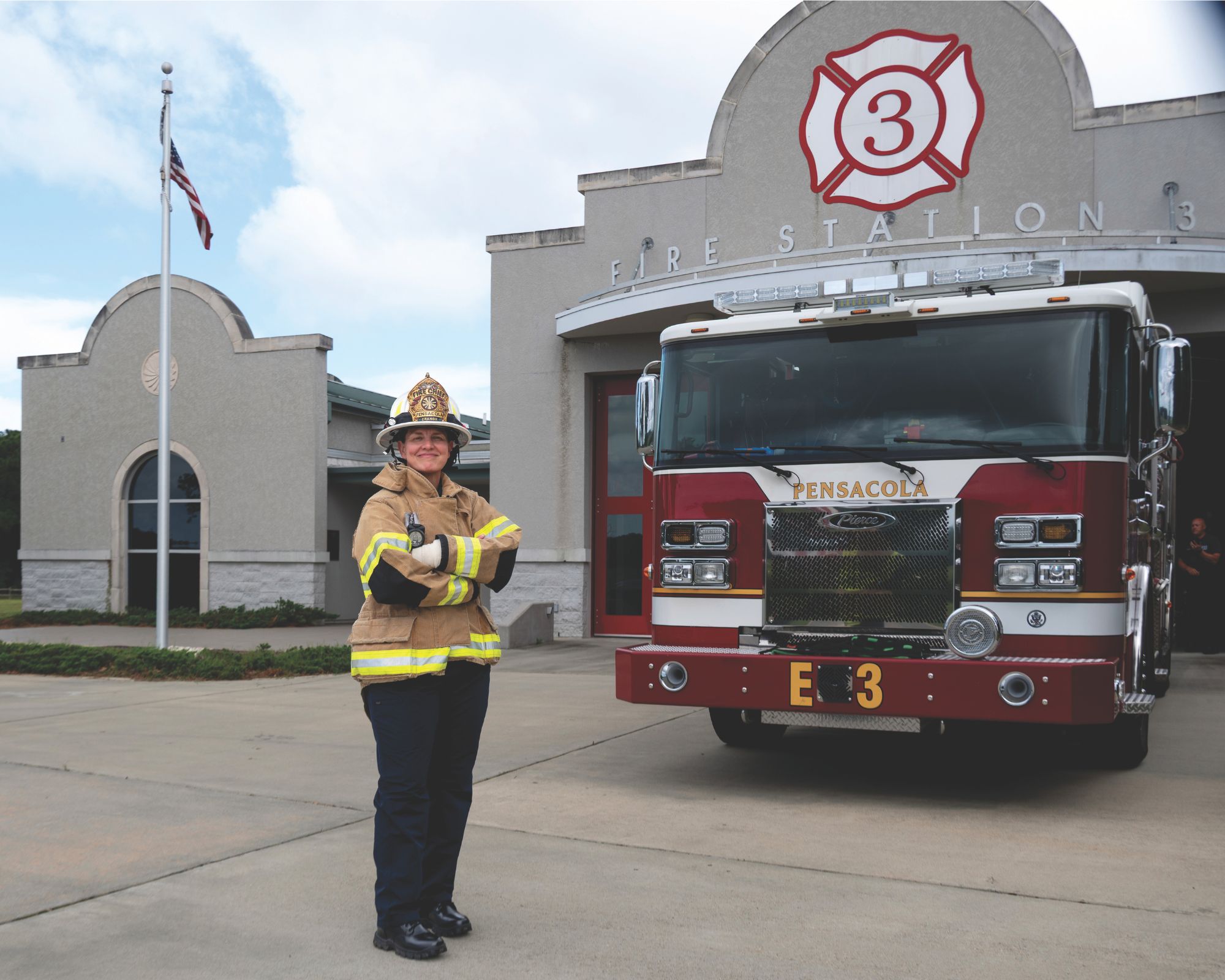
Chief Ginny Cranor has that special spark it takes to do the tough yet rewarding work of a firefighter. She says it takes juggling the delicate balance “between the joy and the trauma” of the job.
Cranor’s career spans 33 years, with the last eight at the helm as PFD chief.
Her role is unique because women make up only 6% of fire chiefs in the United States.
There are more than a million firefighters in the U.S., but it’s largely a male-dominated field with as few as 9% who are female.
Two other women work alongside Cranor at the PFD.
Angela Rockstad started at just 19 as a volunteer firefighter. Now she has 25 years of service under her belt.
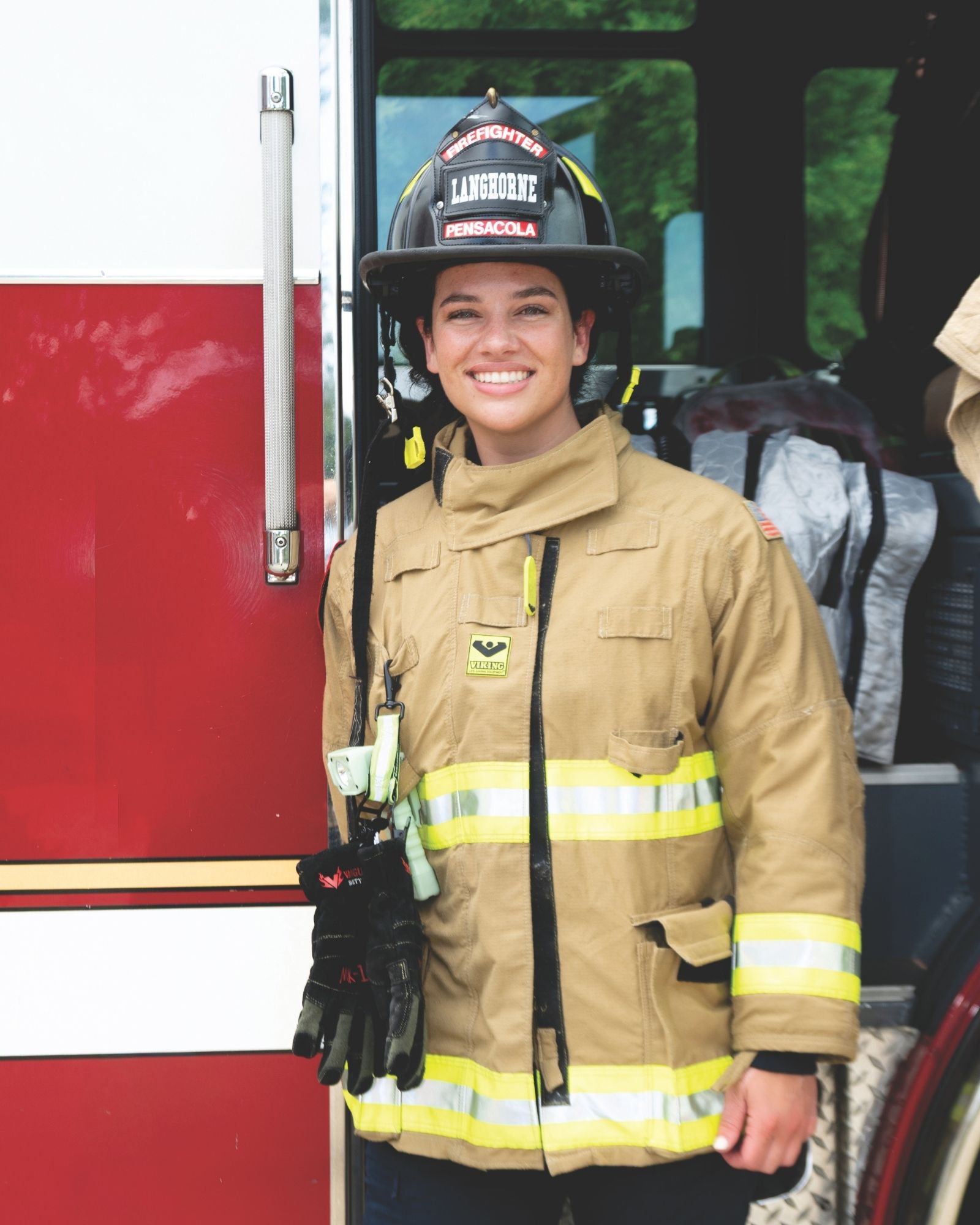
Twenty-five-year-old Meg Langhorne is new to the career. She started with the department as a cadet and has served as a firefighter for two years.
Although still a firefighter, Langhorne has a temporary reassignment in administration, working as a communications and engagement liaison. She loves experiencing the administrative side of the job as well because she gets to be involved in community outreach like her mentor, Cranor.
Her reason for choosing to become a firefighter is simple.
“I wanted something that was challenging. I was looking for something with direct service within the community.”
A Heart for Service
Each of these women has a heart for service.
As a child, Cranor showed her family she had a gift for self-sacrifice and bravery. She was out on a boat with her family. Her mom was water skiing and had quite a tumble.
“It was a really bad tumble, and I was probably 12 years old. The story is like a legend in my family. Now my dad tells it as much as he can. He hadn’t even stopped the boat before I dove in to go get my mom and make sure she was okay.”
At 17, her mom took her to her first CPR class. Then, the summer before college, she was in a restaurant when the owner began choking. She saved his life by performing the Heimlich maneuver.
A hero and rescuer were born. Soon after, she became a firefighter.
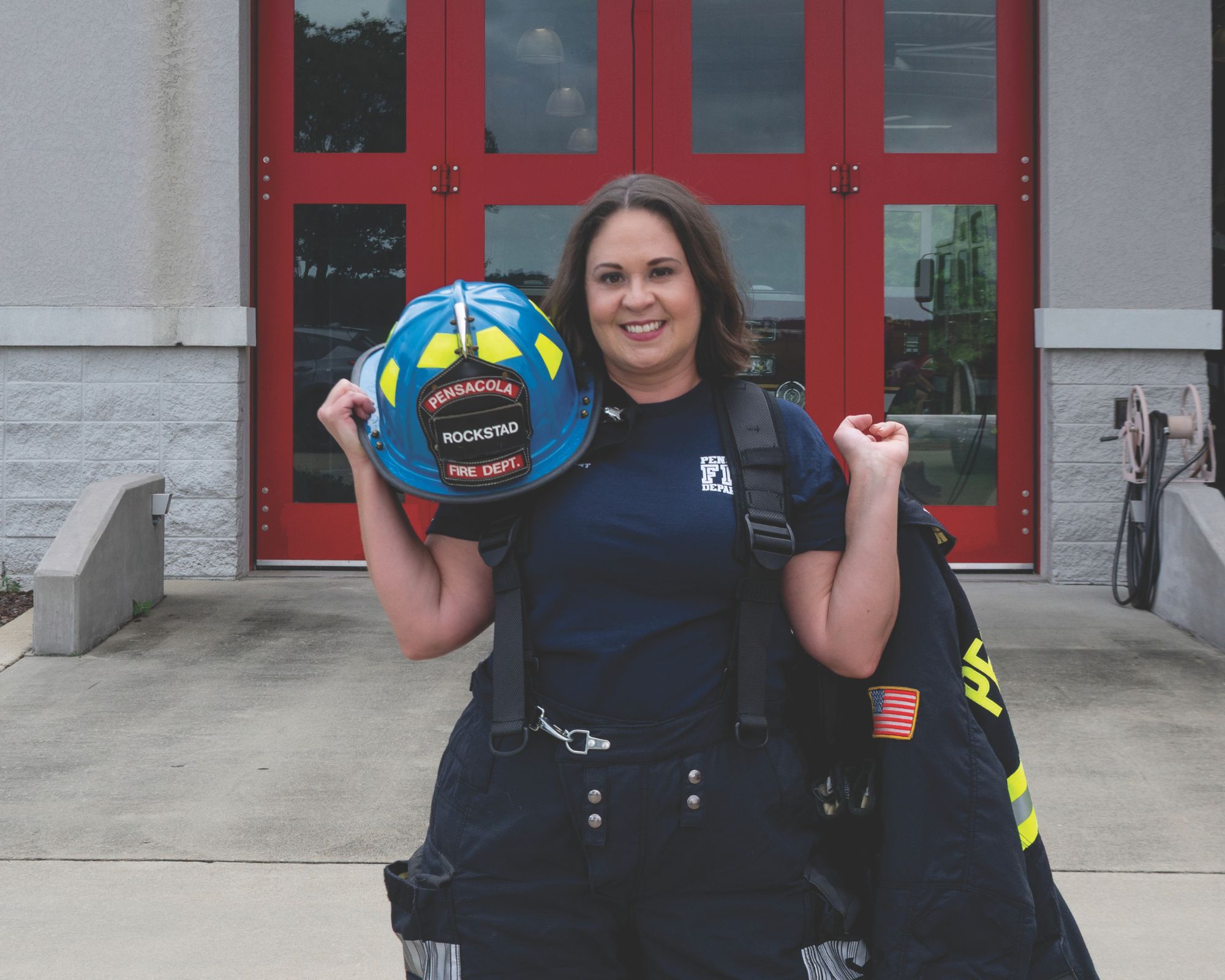
Rockstad’s path into the fire service followed a similar commitment to duty. Standing just 5-foot-1, she hasn’t let her small stature keep her from taking on the physically demanding job. When she first started her career, she’d get some surprised looks when she stepped off a huge ladder truck.
“It was just funny to watch people’s expressions,” she said.
Despite the growing number of women in the profession, many people are still shocked to see a woman wearing the bunker coat and gear.
Rockstad loves going out and being quizzed about what she does for a living.
“I’ll say, ‘I work for the Pensacola Fire Department.’ They’re like, ‘What do you do? Are you the secretary?’ I’m like, ‘No. I’m not.’ I’m proud to say, ‘No, I’m actually a firefighter.’”
The best part is explaining she passed the same physical tests as her male counterparts.
“I mean, I want to brag a little bit!” she laughed.
Physical Requirements
According to the organization “Women in Fire,” male and female firefighters must pass the exact same standardized physical, medical and educational requirements to enter the profession.
“The Candidate Physical Ability Test, or CPAT, is the standard, requiring all candidates to complete tasks like carrying a 165-pound dummy and dragging hoses, regardless of gender, ensuring equal capability to perform life-saving duties.”
When Langhorne decided to try out, she read everything she could about the physical ability test and set out to get in top shape. Knowing that she would have to get used to wearing the heavy flame-proof turnout bunker coat in blazing Pensacola summer heat, she trained outdoors in her winter coat. One of the tests she prepared for was dragging 100 feet of a heavy charged hose.
“It weighs a good bit, and you have to drag it 100 feet, so I tied a kettlebell at the end of a thick rope and then was dragging that around my front yard in a winter coat, so if you drove by my house, it would have looked a little funny!” Langhorne recalled.
Pure determination and grit: that is what Cranor recalls from her time as a fire academy instructor.
“I would frequently have to demonstrate to young men and women how to do appropriate military-style pushups or how to do different parts of our physical abilities exam because it’s not easy and we cannot back off of those standards.”
She recalled showing Rockstad some techniques to compensate for her small size.
Rockstad used her legs rather than just relying on upper-body strength.
“Because my legs and my core is where my strength is…after time you just come up with your own techniques or learn from other women that have been here in the past.”
Special Challenges
Cranor explains the job of a firefighter is, of course, more than just physically demanding.
“First off, it starts with an understanding that you will spend a third of your working lives away from your family and your loved ones, working a 24-hours-on, 48-hours-off schedule.”
If that third day on falls on Christmas or a child’s birthday, the firefighter must put the job first.
Another part of being a firefighter that’s challenging is sleep deprivation.
“That’s another reason that our fitness and nutrition are important,” Cranor said.
Each of the women recognizes the sacrifice but embraces it.
“Because you spend so much time with fellow firefighters, you can’t have ‘an individualistic mindset.’ You’re a team player when you’re a firefighter. You work for the team, not for yourself,” Langhorne said.
She acknowledges the job also takes mental strength because “you’re responding to calls with people on their worst days. You see things that most of the public will never see in their life, and it can take a toll on your mental health. You can’t keep it bottled up.”
Fortunately, there are resources within the department and a chaplain who offers support.
“This job is just so different than most jobs. It becomes the people you work with. They’re not just coworkers. They’re your family.”
Compassion
Cranor says firefighters are “in the business of the worst-case scenario.”
They often see people at their highest and lowest moments. So compassion is a huge part of the special skills required to be a good firefighter.
Cranor recalled a shift in 2002 when she experienced the joy of delivering a baby and then, later that same day, the dramatic extraction of a mother and son from a wrecked car.
Without firefighters and other first responders, she says none of the pieces it takes to rescue a person — such as the ambulance ride and hospital care — will work.
Rockstad believes it does take “a very special woman” to be able to do it.
“It’s just disheartening and sad to see all the pain people suffer. And so that’s made me more empathetic. It opens up my mindset, my mortality.”
Most of her job involves medical calls as an EMT, not just fighting fires, so she sees people of all walks of life and many people — including children and the elderly — living in rough conditions.
“You see a lot of loneliness with these people, especially if they live by themselves, or it’s just the couple, so I always try to be really kind and smile at them because it might be that me and my crew are the only people they see for days at a time.”
Rockstad believes firefighters, whether men or women, must have a healthy fear just to make sure in any situation they are as safe as possible.
“But especially when you know that somebody’s inside a house. It gives you that adrenaline rush to really want to get them out,” she said.
Langhorne added firefighters don’t take the job for money.
“It’s for the service. That’s what I’ve learned from all my senior firefighters, all the people that are way ahead of me because I’m still new. They’ve passed on that knowledge and the reminders that we’re doing this for the community.”
Leaving a Legacy
Cranor is in the Deferred Retirement Option Program, so she will say farewell to the role of fire chief within about three years.
Since she’s worked as many as six jobs during her tenure, including teaching at the fire academy, working as a paramedic and as a registered neonatal nurse, she will continue to serve the community in some capacity.
She hopes her focus on preparation and professionalism will leave a mark on the Pensacola Fire Department. She believes her successes are due to staying true to her values.
“This strikes me over time that consistency speaks louder than stereotypes.”
Her proudest moments have been mentoring new firefighters and seeing them gain confidence, so she encourages both young women and men to join the fire department.
“We need firefighters. It’s getting harder and harder. There’s a shortage of firefighters in the country and in the state of Florida because of the nature of the work, because of the time away from family.”
Her hope is to look back and see the department better than she found it and to look forward to a new chief doing an even better job than she has done.
Yes, she believes that role could very well be filled by another woman.
“You know, I am the first female fire chief for the city of Pensacola, but I don’t want to be the last!”
Women Firefighters TRENDS & STATISTICS
Total Numbers: Estimates say there are between 89,000 and 90,000 female firefighters.
Career vs. Volunteer: A significant portion of female firefighters are volunteers (roughly 72,400), with around 15,000 to 17,200 serving as career firefighters.
Workforce: Women represent approximately 9% of all U.S. firefighters, though some reports indicate as low as 5%.
Leadership: Women make up about 6% of fire chiefs.
Specialty Roles: Approximately 12% of federal wildland firefighters are women.
Growth: The number of female firefighters has increased over the past decade, with organizations like Women in Fire advocating for more women to join.
The First Female Firefighter
Molly Williams is recognized as the first known woman firefighter in the United States. In 1818, she worked alongside firefighters at Oceanus Engine No. 11 in New York City. An enslaved woman, she became known for serving with the crew during a time when a flu outbreak created a shortage of firefighters.

