


Music has set the tone
Virginia Clark’s work is striking a chord with students that will echo far into the future
By Colette Boehm / Photos by Kate Treick Photography
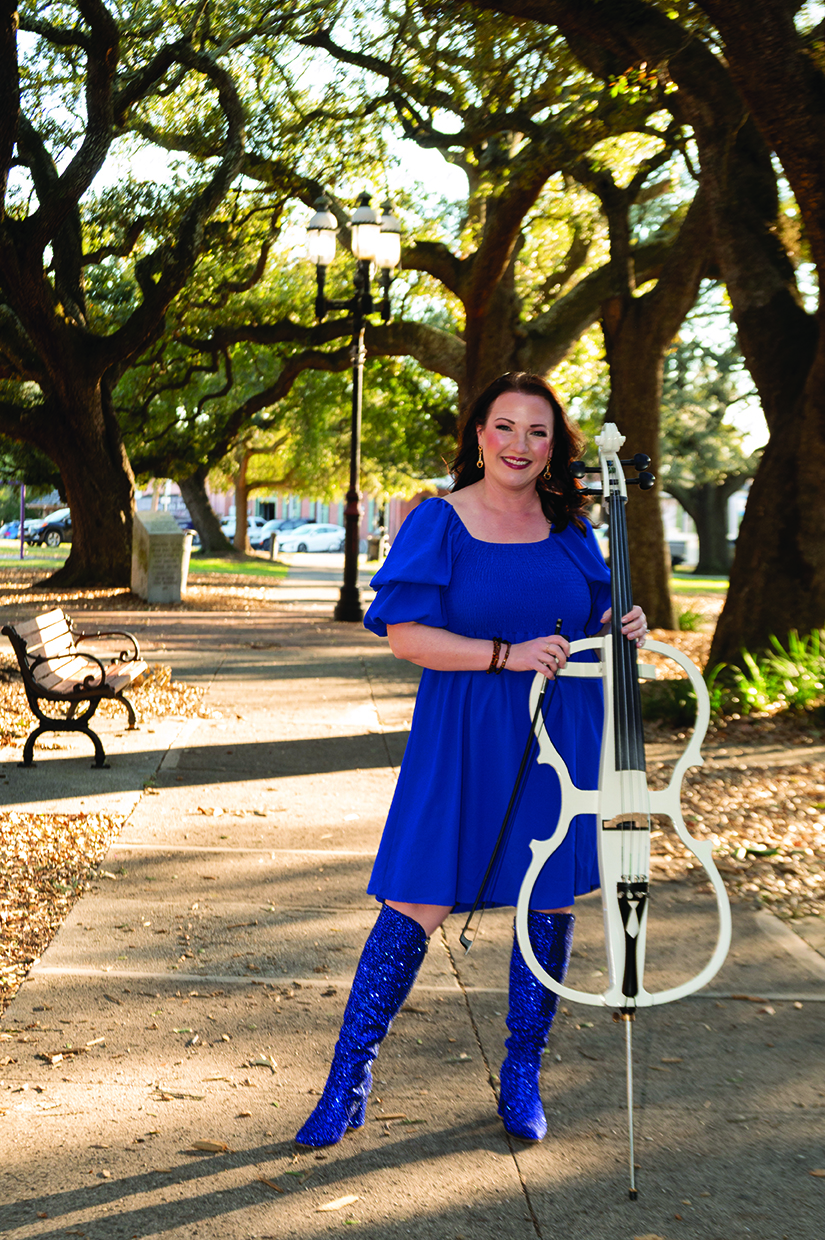
“I’ve always played. I really feel like music set the tone for my life. It truly has led me to everything that I have now and everything I do now.”
That is how Virginia Clark described a journey that began when, as a 10-year-old, she started playing the cello shortly before her family moved from the Chicago area to Pensacola. That decision opened doors not only to a multidiscipline musical career, but also to the family she and her husband have made.
“I started playing cello in Illinois,” she recalled, “and when I moved, the orchestra director here was Cecil Clark, who ended up being my father-in-law. So, I’ve actually known my father-in-law longer than I’ve known my husband.”
While studying with the longtime Northwest Florida musician and instructor, she met his son Jonathan, and the two have been together since middle school. They are now married with two children.
After becoming a certified music instructor, Clark taught in the Escambia County School District for 20 years and currently teaches in the Santa Rosa County system, adding a strings program to its offerings.
“I now teach at Gulf Breeze High School and Gulf Breeze Middle School,” she said. “It’s a part-time job, but it’s enough to be able to do what I love, teach, but still be able to perform and get all my rehearsals in. I get to teach and I get to perform. And I love both.”
That love includes performing as part of the White Tie Rock Ensemble and with the White Tied Quartet.
“I do love performing with the quartet,” she said, “because I get the best of both worlds. I can be playing some Mozart quartets, or I can be playing Led Zeppelin. That group scratches both itches, to be able to do both.”
Perhaps her biggest joy in music, is seeing young musicians blossom into successful performers. The quartet scratches that itch, also. Her fellow musicians in the group are all women who used to be her students. Originally formed to play with the orchestra, the foursome is known for “bringing the classics” to its live rock and roll experiences. The group now also plays gigs of its own, with both electric and acoustic sets.
“It’s fun to be able to play, performance-wise, with grown-up women who I’ve known since they were 10 years old,” Clark said.
Preparing those and many other 10-year-olds to become successful is something she is passionate about. In addition to her work in the school system, she is also the artistic director of ECHO, the Emerald Coast Honors Orchestra. This private organization’s mission is to nurture young musicians through providing them with performance opportunities and the tools and experience they need to persevere.
Unlike traditional youth orchestras, ECHO goes beyond the classical repertoire, specializing in performing music that connects with and inspires young musicians. From rock and roll to film and television soundtracks, the orchestra showcases a variety of sounds in a fresh, contemporary way in a variety of venues. Those performances include collaborations with the White Tie Rock Ensemble, where students have the opportunity to perform alongside professional musicians and explore a wide range of genres.
The overall experience, she noted, teaches students that being the best musician is not always the key to success. ECHO allows her the opportunity to expand on the standard curriculum of public-school programs to help students achieve that success.
“Educationally, yes, we’re teaching them to the play instruments,” she said of public music education, “but we’re not teaching them how to show up on time, what to wear, what questions to ask, how to advertise, how to make a contract, how to book a gig.”
These are the things, she believes, that prepare students to have a sustainable career.
“Whether it’s while you’re a kid in college learning to play for weddings or whether you’re trying to be a professional touring musician, there’s a lot more that goes into that than just the playing of the instrument. It is step by step, solely based on the harder you work, the better you will be. And that benefits everything. I don’t care if you never pick up a violin again once you graduate. The fact that you’ve learned that working produces results and that working at a skill will make you better at that skill, is applicable to any field in life. Whether you want to be a doctor, a professional athlete or whatever the case may be, that is the lesson.”
“You have to show kids,” she continued, “that there is a pathway that works for them. Or why would they invest their time and their effort? I think trying to be relatable, just being able to say, ‘Look, I was a kid that had a bad audition and sat in the back of the orchestra, but then the next semester, I was the kid who had a better audition and sat closer to the front of the orchestra.’ I think relatability is what makes educators successful.”
Clearly, Clark has become very successful in her efforts, as her young musicians mature and make their mark in the musical world. A half-dozen of her former students are now orchestra teachers. Others have become professional musicians. And one is currently serving as the president of the Florida Orchestra Association.
“By and large,” she noted, “my students have been so successful professionally in whatever they choose to do. It is rewarding to see. That truly is what I’m the happiest about professionally. Seeing my kids succeed.”

